2026年10月15日星期四

How Do DIN Standard Strainer Valves Protect Critical Pipeline Equipment?


https://www.yuandavalves.com/news/din-standard-strainer-valves-for-industrial-pipeline-systems.html

DIN standard strainer valves are pipeline components designed to capture solid debris before it reaches pumps, meters, and control valves. They exist because untreated process fluids—whether water, steam, chemicals, or oil—carry scale, weld slag, and rust that destroy expensive equipment. This article explains how these strainers work, what the DIN standards actually specify, and how to select the right configuration for your system.


What Makes a Strainer Valve “DIN Standard”?

A DIN standard strainer valve is a mechanical filtration device manufactured to comply with Deutsches Institut für Normung (DIN) dimensional and testing requirements. The “DIN” designation refers not to a single product but to a family of standards governing face-to-face dimensions, flange drilling, pressure testing, and material specifications.


The most consequential standards for strainer selection include:


DIN EN 13709:2003 – Design standard for industrial valves, defining construction and performance criteria


DIN EN 558 – Face-to-face and center-to-face dimensions, ensuring drop-in replacement compatibility across manufacturers


DIN EN 1092-1 – Flange dimensions and drilling patterns for PN-rated connections


DIN EN 12266-1 – Pressure testing procedures, including shell strength and seat leakage acceptance criteria


This standardization matters because it allows procurement engineers to specify a strainer by DN size and PN rating, then source from multiple qualified suppliers without redesigning piping layouts. A DN100 PN16 Y-strainer from one DIN-compliant manufacturer will match the face-to-face dimension and flange bolt pattern of another.


Y-Type vs. Basket Strainers: Choosing the Right Configuration

The two dominant DIN-compliant strainer configurations serve fundamentally different operational needs. Understanding the trade-offs prevents both under-filtration and unnecessary pressure loss.


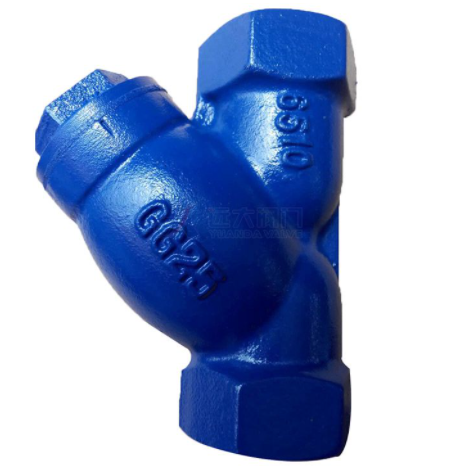
Y-type strainers feature a compact, angled body that installs directly in the pipeline run. The Y-shaped geometry provides a relatively large screening area while maintaining a small footprint . These strainers handle pressures up to 400 bar in steam service and are the default choice for horizontal or vertical pipelines where space is constrained . Their limitation is dirt-holding capacity: size-for-size, a Y-strainer captures less debris than a basket design, requiring more frequent cleaning .


Basket strainers use a vertically oriented chamber with a large removable basket. The increased surface area reduces pressure drop and extends cleaning intervals, making them preferred for viscous fluids, high-flow liquid systems, and applications with heavy particulate loading . Basket strainers typically require horizontal installation and may need structural support at larger sizes .


A practical selection rule from the Fluid Controls Institute: choose Y-strainers when compact inline installation is the priority; choose basket strainers when dirt-holding capacity and low pressure loss matter more than space .


Pressure testing follows DIN EN 12266-1, which mandates shell tests at 1.5 times the design pressure and seat leakage tests at 1.1 times design pressure . For a PN16 strainer, this translates to a shell test pressure of 24 bar. Test durations range from 2 minutes for small sizes (NPS ½–4) to 30 minutes for NPS 20 and above .


Material selection drives both cost and service life. Carbon steel bodies suit non-corrosive media, while CF8M (316 stainless) handles aggressive chemicals and high-purity applications. The screen element is typically stainless steel regardless of body material, as it must resist erosion from captured particles.


Installation and Maintenance Best Practices

Correct installation directly affects strainer performance and maintenance frequency. The orientation rules are straightforward but frequently violated.


For Y-type strainers in horizontal liquid lines, the pocket should point vertically downward. This ensures captured debris settles into the pocket and does not re-enter the upstream pipework during low-flow conditions . In horizontal steam or gas lines, the pocket should be oriented in the horizontal plane to prevent condensate accumulation .


Basket strainers require horizontal installation with the basket housing oriented vertically. Larger units need base support to prevent stress on flange connections .


Maintenance intervals depend on debris loading. A blowdown valve fitted to the strainer cap allows cleaning without system shutdown by using line pressure to flush captured solids . For basket strainers, keeping a spare basket on hand enables immediate swap-out during cleaning, minimizing downtime . Screens should be inspected for perforation damage and replaced if the mesh is distorted.


FAQ

What is the difference between a DIN strainer valve and a standard Y-strainer?


A DIN strainer valve is manufactured to specific DIN dimensional and testing standards—most notably EN 558 for face-to-face length and EN 1092-1 for flange drilling. A “standard” Y-strainer may follow ASME, JIS, or manufacturer-specific dimensions. The practical difference is interchangeability: DIN-compliant strainers drop into European piping systems without adapter flanges, and their pressure testing follows EN 12266-1 rather than API 598 or equivalent .


What pressure rating should I specify for a DIN strainer valve?


Specify the PN rating to match or exceed your system’s maximum operating pressure, then verify that the strainer’s pressure-temperature rating at operating temperature remains adequate. PN16 strainers cover most water and HVAC applications; PN25 and PN40 suit higher-pressure steam and process systems . Note that allowable working pressure decreases at elevated temperatures—a PN40 carbon steel strainer rated for 40 bar at ambient may only handle 24 bar at 400°C .


How do I determine the correct screen mesh for my application?


Screen selection balances particle capture against pressure drop. Standard DIN Y-strainers ship with 0.8 mm perforations for small sizes and 1.6 mm for larger sizes . Finer mesh captures smaller particles but increases pressure loss and cleaning frequency. For pump protection, a common rule is to select a screen opening approximately one-third the size of the smallest critical clearance in downstream equipment. Consult the strainer manufacturer for custom mesh options when standard perforations are insufficient.

2024年8月22日星期四

Are Globe Valves Good for Flow Control?


https://www.yuandavalves.com/globe-valve-wholesale/

When it comes to regulating and controlling fluid flow, choosing the right valve is crucial for both efficiency and safety. Globe valves are one of the most popular types of valves used in industrial applications for flow control. In this article, we will explore the advantages and limitations of globe valves in controlling flow and how they compare with other valve types. We aim to provide a comprehensive understanding of whether globe valves are suitable for flow control in various applications.


What Are Globe Valves?

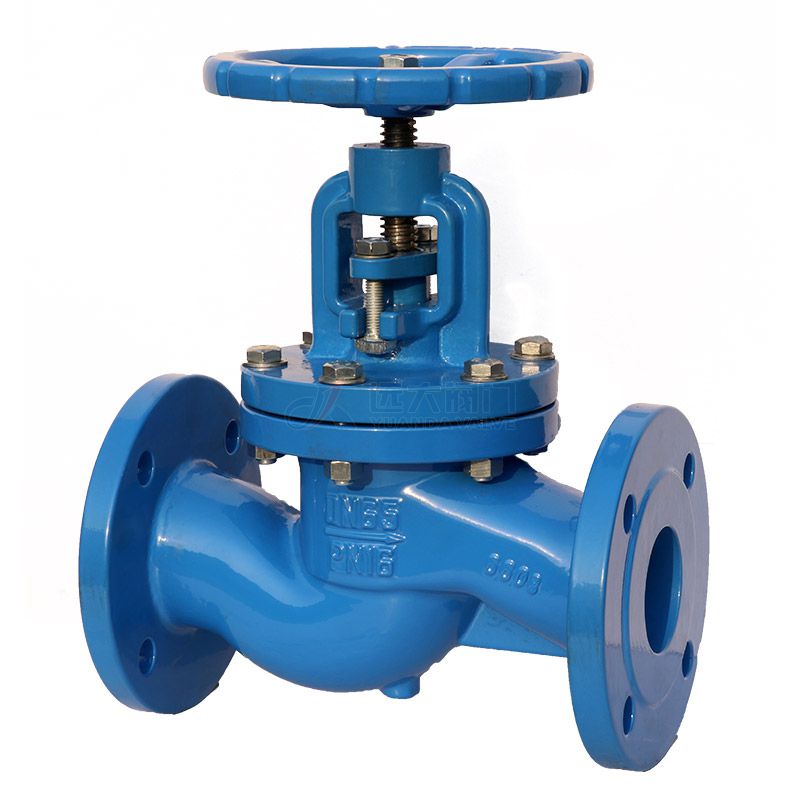
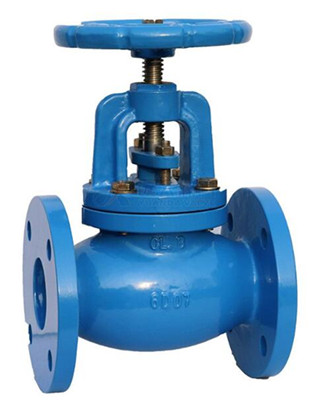
Globe valves are designed with a globe-shaped body, which is why they are named as such. Inside the valve, there is a movable disc or plug, which closes against a stationary ring seat to regulate the flow of liquid or gas. The disc's linear movement either blocks or allows fluid to flow through the valve. Unlike other valves, such as ball or gate valves, which offer a more on-off operation, globe valves are excellent at modulating flow, making them ideal for applications where precise flow control is needed.


Why Are Globe Valves Preferred for Flow Control?

Accurate Flow Control

One of the standout features of a globe valve is its precision in controlling flow rates. Due to its design, it allows operators to control the fluid flow with a high degree of accuracy, making it well-suited for situations where the flow needs to be regulated rather than completely stopped or allowed to pass through unimpeded. The disc can be adjusted to various positions, providing fine-tuned control.


Minimal Leakage

Globe valves offer excellent sealing capabilities due to the nature of their construction. The seating design, which involves the disc pressing against a seat, ensures a tight seal when closed. This minimizes the risk of leakage even in high-pressure systems. In situations where controlling the flow of hazardous fluids is critical, this feature becomes particularly valuable.


Versatility in Different Applications

Globe valves can be used in a wide range of applications including the regulation of gases, liquids, and steam. Industries such as power generation, chemical processing, and oil and gas frequently rely on globe valves to maintain optimal flow rates under varying conditions.


Linear Motion Advantage

The linear motion of the disc in a globe valve allows for greater control over throttling. Unlike other valve types like gate or butterfly valves, which operate using rotary motion, the linear movement of the disc helps distribute the pressure more evenly and provides better throttling capabilities over a range of flow rates.


Advantages of Globe Valves for Flow Control

1. Precise Throttling Capabilities

Globe valves offer superior throttling capabilities compared to other valves. The unique design of the disc and seat allows for gradual changes in flow, making these valves ideal for applications that require a steady and controlled flow. Industries such as water treatment, HVAC systems, and chemical plants depend on the fine-tuned control provided by globe valves to manage fluid flow effectively.


2. Pressure Regulation

Another key advantage of globe valves is their ability to manage pressure drops effectively. Because of the gradual opening and closing mechanism, globe valves can reduce pressure surges that could damage piping systems or equipment. This makes them an excellent choice for applications where pressure regulation is crucial.


3. High Durability

Globe valves are built to handle extreme conditions, making them suitable for high-temperature and high-pressure applications. The materials used in the construction of globe valves, such as stainless steel, carbon steel, and other alloys, provide them with excellent durability, ensuring a long operational life with minimal maintenance.

2024年3月19日星期二

A Guide to a Strainer Valve


What is a strainer valve?


A strainer valve can be specified as a pipe installation whereby fluid is masqueraded purification, filtering, or separation from strong matter; anything made use of to stress a fluid; any type of device working as a screen or filter made use of to avoid solid bodies from mixing in a liquid stream or circulation line. Filters arrest pipe particles such as scale, rust, jointing substance, and also weld metal in pipes, protecting equipment and procedures from their hazardous effects, hence lowering downtime and also upkeep.


Strainer Valve


Types of strainer valves


Strainers can be categorized right into 2 primary types according to their body setup: Y-type as well as T-type (or basket type).


Y-type Strainer


A Y-type strainer valve takes its name from its arrangement as well as is most typically used in pressurized lines, gas, or fluid. They can additionally be utilized in suction or vacuum conditions. Y-Strainers are intended for applications where percentages of strong particulate are anticipated and where clean-out will certainly be seldom. If solids are flushed easily from the screen, as well as the liquid can be exhausted to the ambiance, a blow-down valve on the drain port will certainly permit clean-out without elimination of the display and also without interrupting the process flow.


A Y-type strainer has the advantage of being mounted in either a straight or upright position. Obviously, in both situations, the testing component has to get on the drawback of the strainer body so that the entrapped product can be correctly gathered in it.


In straight heavy steam or gas piping, a Y-type strainer ought to be installed in such a fashion so that the pocket is in the horizontal plane. This stops water from gathering in the pocket which can create erosion and impact warm transfer procedures.


In liquid systems, the pocket ought to aim vertically downwards. This makes certain that the gotten rid of particles are not drawn back right into the upstream pipework during reduced circulation problems.


Although it is suggested to install strainers in straight lines, this is not always possible, and they can be set up in vertical pipes if the circulation is downwards, in which instance the debris is naturally guided right into the pocket.


Some manufactures decrease the dimension of the Y -Strainer body to save material as well as cut the price. Before installing a Y-Strainer, make sure it is big sufficient to effectively handle the flow. A discounted filter might be an indicator of an undersized unit.


T-type or Basket Strainer Valve


T type or basket type or pot type strainer is specified by a vertically related chamber, normally larger than that of a Y-type strainer. Dimension for size, the stress drop throughout a basket strainer is less than that throughout the Y-type as it has a better complimentary straining area, which makes the basket type filter the preferred kind for liquid applications. As the dust holding ability is additionally higher than in Y-type strainers, the basket type strainer is additionally utilized on larger diameter heavy steam pipelines.


Basket strainers can only be set up in horizontal pipes, and for bigger, heavier basket strainers, the base of the strainer requires to be supported.


To service a basket type strainer, the cover can be gotten rid of so specialists obtain instant accessibility to the filtering element if it requires a substitute (because of accumulated debris). When basket type strainers are made use of on heavy steam systems, a substantial amount of condensate may be formed. As a result, strainers designed for use in steam systems normally have a drain plug, which can be fitted with a heavy steam catch to remove the condensate.


Distinctions between Strainer Valves and Filters


A filter is a device that gets rid of fragments from a liquid or gas. It consists of a disposable medium to remove bits of specified micron dimensions. All strainers are filters, yet not all filters are strainers. A filter is only one sort of filter. A strainer valve uses a perforated plate or screen mesh to eliminate bigger bits from a procedure stream. The significant advantage of a Filter is that it is reusable. The filter display is only made use of as soon as and needs to be altered when it is blocked.


The main distinction seems to be in the size of the holes in the media display also described as mesh dimension when it comes to the strainer. There is no hard and fast size department to define filters from filters.


An additional distinction is a resistance. Strainers usually present reduced resistance to fluid circulation. The pressure decrease throughout most filters is reasonably little contrasted to the stress decline throughout thick media filters or membrane filters.


Lastly, is their feature. A strainer is used to secure various other downstream devices from damage by rogue scrap. A filter is utilized to divide particles from the liquid.


We are a strainer valves supplier, please feel free to contact us if you need them.

2024年3月14日星期四

Gate Valve VS Globe Valve

Globe valves and gate valves are the two most common types of valves in industrial plants. Both are designed to make the system run as efficiently and safely as possible. However, contrary to popular belief, these valves are not the same.

These valves have similar valve bodies, but they have their own unique designs and applications.


Globe valves

Glove valve

Globe valve


Globe valves vs gate valves are designed for many applications in several fields, including the oil and gas industry. However, the function of each valve is not the same.

The globe valve is usually used to stop, start and adjust the flow in the pipe. They are composed of a spherical body and a disc. The disc in the globe valve is designed to move up and down from the valve seat. When the valve begins to close, these vertical movements allow the space between the disc and seat to slowly change. This gives the valve a good throttling capability and allows it to adjust the flow in the pipeline.

The flow rate of the globe valve depends on the space between the disc and the seat. The further apart they are, the more liquid will flow through the valve.

The stem of the globe valve is also connected to the bonnet right above the disc to maintain a tight seal when the valve is fully closed. Because of this, compared with other valves, the globe valve is less likely to experience seat leakage.

These valves can double as control valves and are usually used in corrosive, highly viscous media and high pressure and high-temperature systems.


Gate valves

Gate Valve

Gate valve


Gate valves are also used in factories in the oil and gas industry. However, they are designed only to start and stop the fluid in the piping system. Unfortunately, they cannot regulate flow.

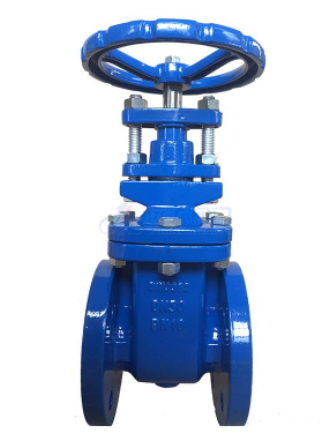
The structure of the gate valve is also different from that of the globe valve. Instead of a disc, these valves have gate faces that are parallel or wedge-shaped, they are designed with a rising or a non-rising stem. This helps workers understand when the valve is fully open or fully closed.

It is well known that these valves have a lower pressure drop and have little resistance to fluid flow, especially in the fully open position. Most importantly, the gate valve can be set in any directional flow. Globe valves, on the other hand, can’t.


The Differences Between Gate Valve And Globe Valve


ㆍStructure

One of the main differences between gate valves and globe valves is how these look. The gate valve structure is much simpler. Most of its internal components are located on the top part of the valve body. When it is opened, its body becomes hollow. This is why there is a little pressure drop. The gate valve can have a rising stem or a non-rising stem.

On the contrary, many globe valve parts are inside the cavity. Since its main purpose is to throttle and provide positive closure, this design allows obstacles to help the globe valve achieve this purpose. This design also allows the flow direction and flow rate to be changed, resulting in a high-pressure drop. This globe has a rising stem.

ㆍApplication

This gate valve is suitable for applications where a low-pressure drop is critical. This is a multi-directional valve. The globe is best used in applications where massive changes in pressure are not an issue. This valve is unidirectional.

ㆍFunction

The gate valve is not designed for flow control; it is for the isolation of media. The gate valve cannot handle the strength of the medium flowing in the partially opened state. On the other hand, the globe valve is more of a control valve.

ㆍHow They Work

In the gate valve working mechanism, the disc lodges between the seats. Its movement is at the right angle in relation to the media flow. It provides either full flow or no flow at all. If you open the valve, the flow space is as big as the valve cavity with little extra where the stem and the seats are located.

The globe valve disc, on the other hand, moves parallel to the media flow. A full flow means the disc only has to move a little from the seat. Its design allows throttling and tight shutoff.


Conclusion


A fascinating facet of valves is that they may look the same but they can function quite differently. This remains true in the case of gate and globe valves. If you are seeking an industrial valve supplier, you can choose manufacturers Yuanda in China. Contact us now!

2024年3月11日星期一

Differences Between Cast Iron And Cast Steel Valves

One of the most prominent ways to make enduring and also quality parts is with spreadings. Casting enables a high degree of information, which leads to not requiring as well as additional fabrication or setting up. While several products can be cast, steel and iron are both the most popular as a result of their outstanding mechanical properties for a variety of applications.

Cast iron normally describes grey iron, pliable iron, and also malleable iron. Which is an iron casting with a carbon web content of more than 2%.

Cast steel usually describes normal carbon steel and alloy steel. Which is steel spreading with a carbon web content of less than 2%.

For that reason, no big difference between the chemical content and also raw materials for cast iron vs cast steel.


Differences Between Cast Iron And Cast Steel


Deterioration Resistance


When it involves corrosion, iron has better deterioration resistance than steel. That doesn't suggest that either is unsusceptible deterioration though. When left unprotected, both metals will oxidize in the existence of wetness. Eventually, they will completely decay. To prevent this, the coating is suggested for both steel as well as iron spreadings.


Expense


Cast iron is frequently less expensive than cast steel because of the reduced product costs, energy, and labor needed to create an end product. While raw steel is extra costly, there are, nonetheless, prefabricated kinds of steel. Those consist of sheets, poles, bars, tubes, and beams of light.


Castability


Cast iron is fairly simple to cast, as it puts conveniently and does not diminish as much as steel. This flowability makes cast iron a suitable metal for architectural or ornate ironwork frameworks such as fencing and road furniture.


The advantages and disadvantages of cast iron


The grey cast iron's good casting residential properties are excellent vibration damping, good wear resistance, excellent machinability, and reduced notch level of sensitivity. However, its tensile toughness as well as prolongation are very low. So, it can just create some steel parts with reduced physical requirements. Needs such as safety cover, cover, oil pan, handwheels, framework, floor, hammer, small manage, base, frame, box, knife, bed, birthing seat, table, wheels, cover, pump, valve, pipeline, flywheel, electric motor blocks, etc. When it comes to greater qualities, grey actors iron can withstand better load and also a particular degree of rigidity or deterioration resistance. This permits a few of the more important spreadings such as a cylindrical tube, equipment, base, flywheels, bed, cylinder block, cylinder lining, piston, transmission, brake wheel, combining plate, medium pressure valve, and so on.


Ductile iron and malleable iron have high stamina, ductility as well as heat-resistance, and also strength. So a bigger application, sometimes, can replace carbon steel. However, its production innovation is high. The production process is a lot more complex. This makes the production expense higher than regular grey cast iron and also cast steel. Therefore, there are a lot more casting issues for pliable iron. Numerous areas make use of ductile iron, such as stress pipelines and installations, automobile applications, farming, road and building applications, and general engineering applications.


The advantages and the disadvantages of cast steel


The major benefit of cast steel is layout versatility. The developer of the casting has the best liberty of layout choices. This permits intricate shapes as well as hollow cross-section components.

Cast steel has metallurgy manufacturing flexibility and also the toughest variability. One can choose various chemical structures and controls that are adapted to the numerous needs of different projects. This provides various heat treatment choices in the larger context of the mechanical properties and also performance. Also using great weld-ability and also workability.

Cast steel is a type of isotropic material and also can be made into general architectural strength steel spreadings. This improves the dependability of the task. Coupled with the layout and weight, the advantages of short delivery time, price, and also economic situation offer cast steel a competitive advantage.


The weight variety of steel castings is larger. Little weight can be only a few grams of liquified mold accuracy spreadings. The weight of large steel castings rises to several tons, lots of lots, or numerous loads.

Steel castings can be used for a range of functioning problems. Its mechanical residential or commercial properties are superior to any other spreading alloys, and a variety of high-alloy steel for unique objectives. To endure high tensile tension or the vibrant load of parts, it is important to take into consideration pressure vessel castings. In low or high temperatures, huge as well as fundamental part tons essential components ought to offer priority to steel castings.

However, cast steel has fairly negative shake-suction, use resistance, and mobility. The casting efficiency, contrasted to cast iron, misbehaves. Also, the costs are more than normal actors iron.

As a result, cast iron vs cast steel, have their very own benefits and downsides. Either should be chosen according to the application and also their physical residential or commercial properties.

2024年3月5日星期二

What Are the Commonly Used Check Valves?

 Contents:

ㆍUse of wafer check valve

ㆍThe main material of the wafer check valve

ㆍStandards and specifications of wafer check valve

ㆍThe structural characteristics of the wafer check valve


Check valve is also called one-way valve or check valve, its function is to prevent the medium in the pipeline from flowing back. The bottom valve of the pump to close the water is also a check valve.

The valve that opens or closes on its own by the flow and force of the medium to prevent the medium from flowing back is called a check valve. Check valves belong to the category of automatic valves, which are mainly used in pipelines where the medium flows in one direction, and only allow the medium to flow in one direction to prevent accidents.

Cast iron check valves are divided into three types: lift check valves, swing and lift check valves and butterfly check valves. Lift check valves can be divided into two types: vertical check valves and horizontal check valves. Swing check valves are divided into three types: single-leaf check valve, double-leaf check valve, and multi-leaf check valve. The butterfly check valve is a straight-through check valve. The above-mentioned check valves can be divided into three types in connection form: threaded check valve, flanged check valve, and welded check valve.


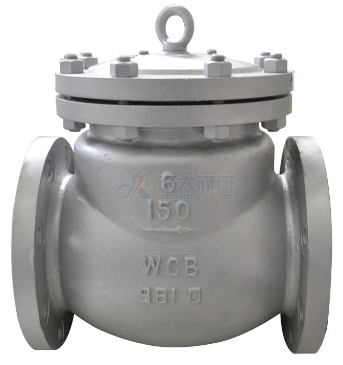
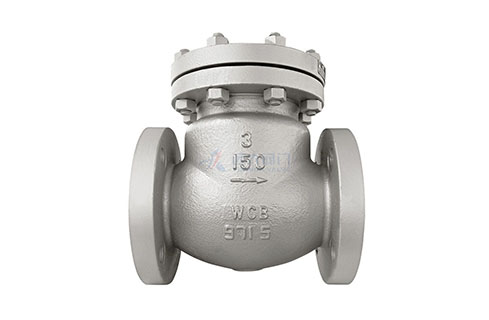
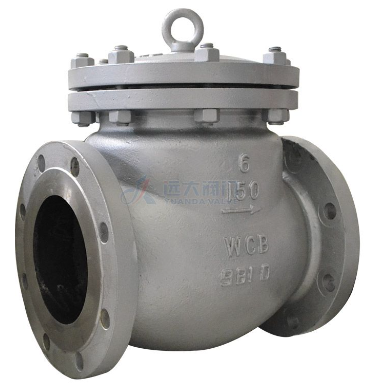
Swing and Lift Check Valve


The installation of the check valve should pay attention to the following: 1. Do not make the check valve bear weight in the pipeline, and the large check valve should be independently supported so that it is not affected by the pressure generated by the piping system. 2. When installing, pay attention to the direction of medium flow should be consistent with the arrow direction of the valve body. 3. Lifting vertical flap check valve should be installed on the vertical pipeline. 4. Lifting the horizontal flap check valve should be installed on the horizontal pipeline.

Nominal pressure or pressure level of check valve: PN1.0-16.0MPa, ANSICLASS150-900, JIS10-20K Nominal diameter or caliber: DN15~900, NPS1/4~36 Connection method: flange, butt welding, thread, bearing Suitable temperature for plug welding: -196℃~540℃ Valve body material: WCB, ZG1Cr18Ni9Ti, ZG1Cr18Ni12Mo2Ti, CF8 (304), CF3 (304L), CF8M (316), CF3M (316L), Ti. Different materials are selected, and the check valve can be applied to various media such as water, steam, oil, nitric acid, acetic acid, oxidizing medium, urea, etc.


Use of wafer check valve


The check valve is installed in the pipeline system, and its main function is to prevent the medium from flowing back. The check valve is an automatic valve that depends on the pressure of the medium to open and close. The wafer check valve is suitable for various pipelines with nominal pressure PN1.0MPa~42.0MPa, Class150~25000; nominal diameter DN15~1200mm, NPS1/2~48; working temperature -196~540℃, used to prevent The medium flows back. By selecting different materials, it can be applied to a variety of media such as water, steam, oil, nitric acid, acetic acid, strong oxidizing media, and uric acid.


The main material of the wafer check valve


There are carbon steel, low-temperature steel, duplex steel (F51/F55), titanium alloy, aluminum bronze, INCONEL, SS304, SS304L, SS316, SS316L, chromium-molybdenum steel, Monel (400/500), 20# alloy, Hastelloy, and other metal materials. The use and structural characteristics of the wafer check valve

Swing and Lift Check Valves


Standards and specifications of wafer check valve


1. Design and manufacturing: API594, API6D, JB/T8937, JB/T3595,

2. Structure length: API594, API6D, DIN3202, JB/T8937, ANSI/ASMEB16.10

3. Pressure and temperature rating: ANSIB16.34, DIN2401, GB/T9124, HG20604, HG20625, SH3406, JB/T74

4. Test and inspection: API598, JB/T9092, GB/T13927

5. Piping flange: JB/T74~90, GB/T9112-9124, HG20592~20635, SH3406, ANSI/ASMEB16.5, DIN2543-2548, GB/T13402, API605, ASMEB16.47


The structural characteristics of the wafer check valve


1. The structure length is short, and its structure length is only 1/4~1/8 of the traditional flange check valve

2. Small size and lightweight, its weight is only 1/4~1/20 of the traditional flange check valve

3. The valve flap closes quickly and the water hammer pressure is small

4. Both horizontal pipes and vertical pipes can be used, easy to install

5. Unobstructed flow path and low fluid resistance

6. Sensitive action and good sealing performance

7. The disc has a short stroke and a small closing impact

8. The overall structure is simple and compact, and the appearance is beautiful

9. Long service life and reliable performance


Swing and Lift Check Valve


The role of the check valve in the pump water supply system is to prevent the impact of the high-pressure water backflow on the pump impeller. When the system is running for some reason, when the pump suddenly stops running, the pressure in the pump disappears, and the high-pressure water connected to the outlet of the pump will flow back to the pump in the reverse direction. When the pump outlet is equipped with a check valve, it will be closed immediately to prevent the high-pressure water from flowing back to the pump.

The cast steel check valve is an automatic valve whose main function is to prevent the backflow of the medium, prevent the pump and drive motor from reversing, and release the container medium. Check valves can also be used to supply pipelines for auxiliary systems whose pressure may rise above the system pressure. The main function of the check valve is to prevent the medium in the pipeline from flowing back. The opening and closing parts are opened or closed by themselves by the force of the flowing medium. The check valve is only used in the pipeline where the medium flows in one direction to prevent the medium from returning to prevent accidents. We are a check valve manufacturer. If you are interested in our products, please contact us now!

How Do DIN Standard Strainer Valves Protect Critical Pipeline Equipment?

  https://www.yuandavalves.com/news/din-standard-strainer-valves-for-industrial-pipeline-systems.html DIN standard strainer valves are pipe...